







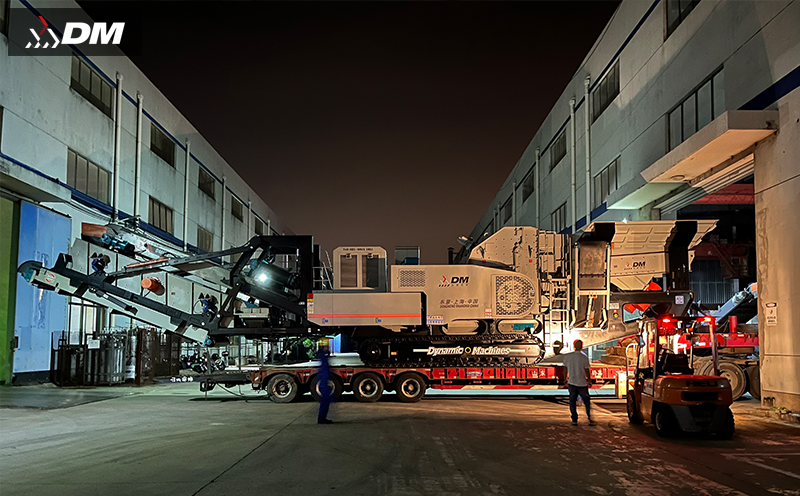
I. Core Pain Points of Crushing Scenarios in Tanzania: Difficult Transfer and Slow Commissioning
Tanzania has a wide distribution of mineral resources, from the gold belts in the north to the rare metal deposits in the south. Most operation sites are far from paved roads; at the same time, infrastructure projects often involve complex scenarios such as highway slopes and temporary aggregate points at ports. Traditional crushing equipment faces two major problems: first, transfer is limited—fixed equipment needs to be disassembled for transportation and takes a long time to reinstall and debug, while ordinary wheeled equipment is prone to getting stuck in muddy mine roads and undulating slopes; second, commissioning efficiency is low—on-site foundation construction and pipeline connection are required, and it usually takes several days from equipment arrival to official crushing, which cannot meet the "rapid response" needs of projects.
More importantly, some operation areas (such as under high material piles and near slopes) have safety risks, and accidental injuries are likely to occur when personnel operate equipment at close range. These pain points lead to low equipment utilization and project delays, directly affecting project profits.
II. Dual Core Advantages: Crawler Movement Solves Terrain Limitations, Remote-Controlled Travel Improves Safety and Efficiency
Targeting the multi-scene crushing needs in Tanzania, the new crushing equipment adopts "crawler movement + remote-controlled travel" as the core design, completely changing the traditional operation mode:
1. All-Terrain Crawler Chassis: "Unimpeded Travel" in Complex Sites
The equipment is equipped with a wide crawler chassis with low ground pressure, which can easily cope with the common muddy roads, gravel slopes and soft mines in Tanzania. The crawler surface adopts anti-skid pattern design, which can maintain stable driving even in wet sites during the rainy season; the chassis height can be flexibly adjusted, which can not only cross small obstacles in the site, but also adapt to feeding platforms of different heights. Whether transferring from the main mining site to the auxiliary mining site, or moving from the highway construction site to the temporary aggregate yard, there is no need to rely on special transportation by large trailers—the equipment can drive to the target location independently, greatly reducing transfer dependence.
2. Remote-Controlled Travel Operation: Safe, Convenient and "Precise Positioning"
Equipped with a wireless remote control system, operators can control the equipment's forward, backward, steering and speed adjustment through the handle within a range of 100 meters, without operating close to the equipment. When working under high material piles, personnel can remotely control the equipment to adjust the crushing position in a safe area; in narrow sites (such as construction corridors of infrastructure projects), precise positioning can be achieved through remote control to avoid equipment collision. In addition, the remote control system supports one-key emergency stop, which can cut off power immediately in case of emergencies, further ensuring operation safety.
III. Immediate Transfer and Operation: No Installation Required, Start Work Upon Arrival
The equipment adopts an integrated design, completely eliminating the complex on-site installation process:
- No foundation construction needed: The equipment is equipped with a stable support structure, no piling or concrete pouring is required after arriving at the site, and it can remain stable after landing;
- Quick connection: The power system and crushing module are pre-integrated, and only fuel or power supply (selected according to equipment type) needs to be connected on-site, no additional pipeline laying is required;
- Short commissioning time: The entire process from equipment arrival at the site, remote-controlled movement to the operation position, to starting the crushing program can be completed in as fast as 1 hour, which is more than 80% more efficient than traditional equipment commissioning.
This "immediate transfer and operation" feature is particularly suitable for temporary crushing needs in Tanzania (such as small-batch ore processing during mine exploration and emergency aggregate supply for infrastructure projects). The equipment can be flexibly dispatched according to project needs to avoid long-term idleness.
IV. Practical Case: "Efficiency Revolution" of a Mining Enterprise in Tanzania
After a mining enterprise introduced 2 sets of this type of equipment in a gold mine project in northern Tanzania, the operation efficiency was significantly improved:
- Transfer efficiency: Transferring from the main mining site to the auxiliary mining site 3 kilometers away, the equipment drove independently, taking only 40 minutes, saving 1 day compared with traditional disassembly and transportation;
- Commissioning time: After the equipment arrived at the new mining site, the operator adjusted the position by remote control, and started crushing 30 minutes after connecting the diesel power, shortening the commissioning cycle by 3 days compared with before;
- Safety guarantee: When working under high material piles, personnel operated remotely 50 meters away, and no safety hazards caused by close-range operation occurred;
- Equipment utilization: Due to convenient transfer and commissioning, the monthly effective operation time of the equipment increased by 12 hours, and the utilization rate increased by 15%.
The person in charge of the mining enterprise said: "In the past, we had to disassemble the equipment, find a trailer, and wait for installation. Now the equipment can drive to the mining site by itself, and it can start working with a remote control—the efficiency is completely different."
V. Practical Suggestions for Adapting to Tanzanian Scenarios
To maximize the equipment efficiency, combined with the operation environment in Tanzania, the following strategies are recommended:
- Transfer planning: Survey the route in advance, clear large obstacles along the way, and ensure the smooth driving path of the crawler; check the wear of crawler patterns before transferring in the rainy season, and replace the anti-skid crawler if necessary;
- Remote control operation: Regularly test the stability of the remote control signal, and avoid using it in areas with strong electromagnetic interference (such as near high-voltage lines); operators must receive professional training and be familiar with safety operation procedures such as emergency stop;
- Daily maintenance: Regularly clean the sand and mud between the crawlers to prevent component jamming; check the battery life of the remote control and prepare sufficient spare batteries to avoid power failure during field operations.
Conclusion
Against the background of complex terrain, scattered operation sites and high safety requirements of crushing operations in Tanzania, the crushing equipment with "crawler movement + remote-controlled travel" has become a key tool to improve project efficiency. It solves the terrain limitations of traditional equipment through crawler movement, ensures operation safety through remote control, and realizes rapid commissioning through integrated design.
From mineral mining to infrastructure construction, this equipment not only improves the flexibility and utilization rate of crushing operations, but also provides a reliable guarantee for the rapid progress and safe operation of projects in Tanzania, becoming a powerful support for project profitability.
If you would like to get help immediately, you can also fill your requirements on the following form, we will contact you on the right time.


Get In Touch